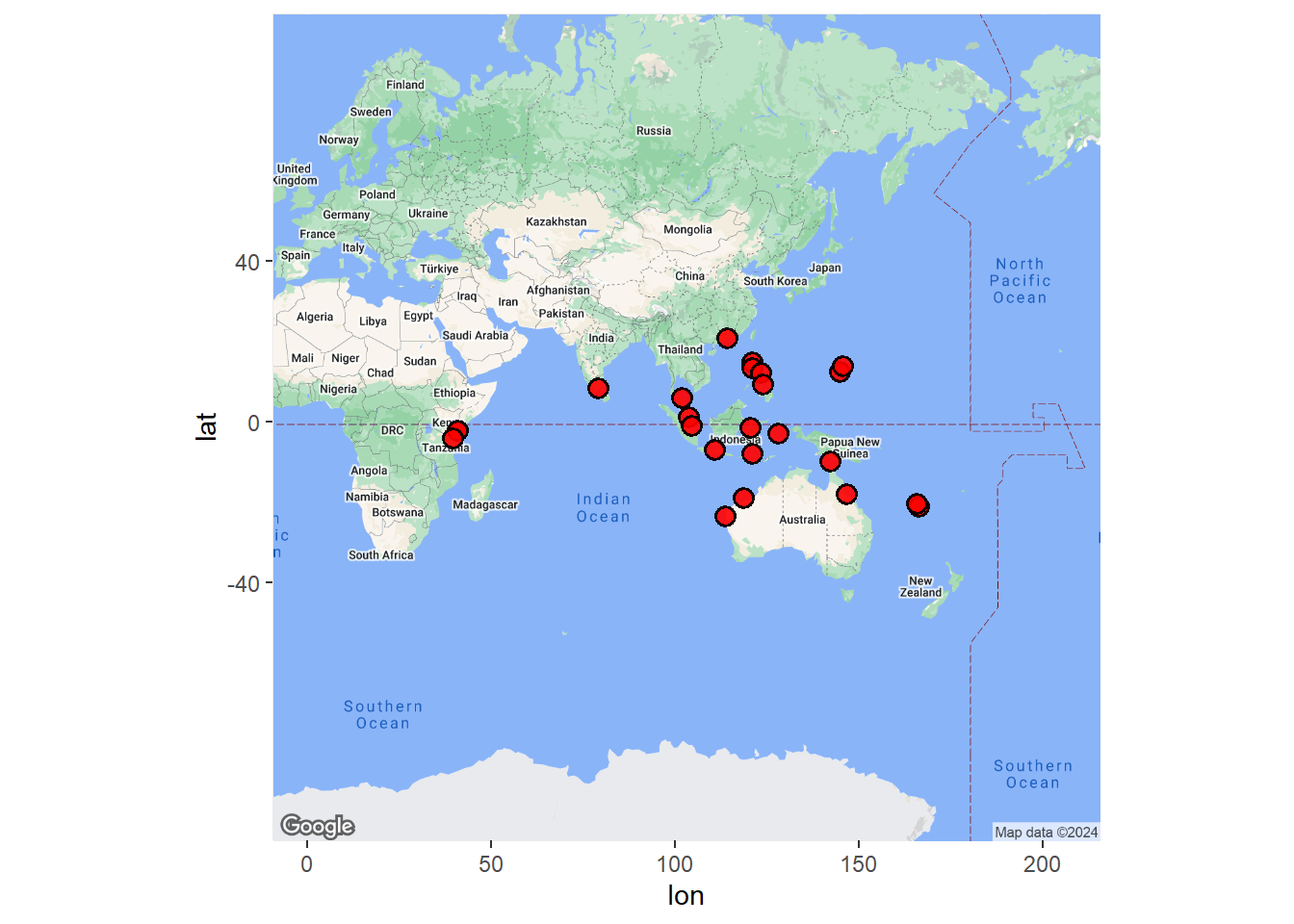
This is a simple test of whether the use of a Large Language Model (e.g., Claude 3) can help organize botanical research materials. Here, we’re deconstructing the herbarium specimen data. The goal is to add visualizations that make the terse text into something that is more usable.
2.1 Source
The starting materials are two pages (252-253) from C. den Hartog’s 1970 book, The Sea-grasses of the World, North-Holland Publishing Company, Amsterdam.
The distribution of Halophila ovata is given in the text.
den Hartog, page 252
den Hartog, page 253
2.2 Initialize Libraries and Data
Show the code
## Standard Librarieslibrary(tidyverse)library(gt)library(gtExtras)## Map Librarieslibrary(sitemaps)library(ggmap)## Useful Librarieslibrary(lubridate)library(stringr)## LLM Librarieslibrary(claudeR)## Test if Google Key is registeredif (!has_google_key()){## Register the Google Maps API Key.register_google(key = My_Key, account_type ="standard") } ## end Google Key testclaude_key <-Sys.getenv("ANTHROPIC_API_KEY")## Use two functions from sitemaps to initialize columneterscolumn <-site_styles()hide <-site_google_hides()
2.3 Start with the OCR Text
This is the manually cleaned-up results from the OCR text produced by Adobe Acrobat. There are still some errors in the text.
Show the code
"KENYA. Lamu, mud-fiats north-west of the town, exposed at low tides, locally extremely common and dense,female fl., fr., 1-7-1965, Mrs. F.M. Isaac A 21 (L). Mokowe, mud-flats in front of mangrove swamp, 30-6-1965, Mrs. F. M. Isaac A 100 (L). - Gazi, south of Ukunda, on mud-flats, uncovered at exceptionally low spring tides only, 11-12-1965, Mrs. F. M. Isaac A 116 (L).INDIA. Pamban, October 1922, M. O. P. Iyengar 133 B (BM). THAILAND. Rawi, Satut, growing in sand, just exposed at low tide, together with Halodule uninervis, 13-1-1928, A. F. G. Kerr 14035 (BM).HoNG KoNG. Cowloon Bay, on sandy bottom at ca. 2 m depth, Harland 282 (K).PHILIPPINES. Luzon: Manila Bay, fr., May 1892, A. Loher 1595 (K, C, P); fl., fr., April 1905, E. D. Merrill 4112 (P, K, L, SYD); Malate Beach, fr., 8-5-1910, C. B. Robinson 9899 (C, P, L, BO); fr., March 1912, E. D. Merrill 1098 (C, U, WRSL). Albay Province, Albay Gulf, near Lubas Point, on sandy mud with Halimeda, below low-tide mark, 18-5-1958, M. Doty &, G. T. Velasquez 16848 (L, HAW). - Cebu: Mactan Island, together with Halophila ovalis and Halodule uninervis, January-February1875, Moseley (BM).MALAYAN PENINSULA. Singapore: Blakang Mati, 1892, Ridley 3780 (C, BM,SING). Ponssol, on sandy mud, exposed at low tide, 5-2-1914, Holttum (SING). Labrador, 21-3-1928, Holttum (SING). Tandjong Behala Kuda, Pulau Pawai, sandy bottom, at half-tide level, growing with Halodule uninervis, 14-3-1950, J. Sinclair 38894 (SING, L). Pasir Laba, in a pure stand in a bed of Halophila ovalis, in the low eulittoral on mud, 27-12-1965, H. M. Burkill 3897 (L).INDONESIA. Riouw Archipelago: Pulau Penyangat, 8-11-1930, Md. Nur 24603(SING). - Java: Pasir Poetih, 27-8-1961, H. F. Neubauer 1601 (L). - Lesser Sunda Islands: Flores, near Bari, 12-7-1847, Zollinger 3334 (Type of Lemnopsis minor, P, L, BM, U); Bima, together with narrow-leaved Halodule uninervis, Zollinger 3431 (P). - Celebes: Salayer, Zollinger (L). - Moluccas: Amboina., October 1874, O. Beccari 11828 (L).MARIANNE ISLANDS. Exact locality unknown, fl., Gaudichaud (Type, P, L). - Guam, Cocos Lagoon, Summer 1952, K. O. Emery 10699 (AHFH). Mana Bayopposite Ypan, on east coast, inside barrier reef, in lagoon at ½-2 m depth, on sandy silty bottom, with scattered Enhalus acoroides, Caulerpa, Padina and other algae, 15-4-1962, B. O. Stone 4063 (L, HAW). - Saipan Island, in lagoon, 22-8-1952, N. 0. Bunker & R. Ocampo (AHFH).WESTERN AusTRALIA. Carnarvon, Babbage Island, in creek through the mangrove swamp, 16-9-1967, 0. den Hartog 560 (L); on tidal flats and in creeks in front of the mangrove-swamp SW.of Carnarvon, 17-9-1967, 0. den Hartog 581 (L). Port Hedland, in small pools in the intertidal belt, on muddy bottom, 18-9-1967, O. den Hartog 588 (L).QUEENSLAND. Thursday Island, a few specimens at low-water mark, 12-11-1967, 0. den Hartog 1016 (L); in very shallow, muddy littoral pools along the NE. side of the island, 12-11-1967, 0. den Hartog 1026 (L). Townsville, between Cape Pallarenda and Shelly Beach, in soft mud at half-tide level, 5-10-1967, 0. den Hartog 743 (L); Townsville, Cleveland Bay, flats of Crocodile Creek, 13-10-1967, 0. den Hartog 797 (L).NEW CALEDONIA. Noumea, on the mud-flats, just below low-water mark, er and !j! fl., fr., April 1869, B. Balansa 1525 (P); Anse Vata near Noumea, in 1-2 m of water, 5-2-1960, M. Angot (L, HAW). Ouano (La Foa District), abundant, er fl., 20-1-1961, H. S. McKee 8229 (K). "
[1] "KENYA. Lamu, mud-fiats north-west of the town, exposed at low tides, locally extremely common and dense,female fl., fr., 1-7-1965, Mrs. F.M. Isaac A 21 (L). Mokowe, mud-flats in front of mangrove swamp, 30-6-1965, Mrs. F. M. Isaac A 100 (L). - Gazi, south of Ukunda, on mud-flats, uncovered at exceptionally low spring tides only, 11-12-1965, Mrs. F. M. Isaac A 116 (L).\nINDIA. Pamban, October 1922, M. O. P. Iyengar 133 B (BM). \nTHAILAND. Rawi, Satut, growing in sand, just exposed at low tide, together with Halodule uninervis, 13-1-1928, A. F. G. Kerr 14035 (BM).\nHoNG KoNG. Cowloon Bay, on sandy bottom at ca. 2 m depth, Harland 282 (K).\nPHILIPPINES. Luzon: Manila Bay, fr., May 1892, A. Loher 1595 (K, C, P); fl., fr., April 1905, E. D. Merrill 4112 (P, K, L, SYD); Malate Beach, fr., 8-5-1910, C. B. Robinson 9899 (C, P, L, BO); fr., March 1912, E. D. Merrill 1098 (C, U, WRSL). Albay Province, Albay Gulf, near Lubas Point, on sandy mud with Halimeda, below low-tide mark, 18-5-1958, M. Doty &, G. T. Velasquez 16848 (L, HAW). - Cebu: Mactan Island, together with Halophila ovalis and Halodule uninervis, January-February\n1875, Moseley (BM).\nMALAYAN PENINSULA. Singapore: Blakang Mati, 1892, Ridley 3780 (C, BM,\nSING). Ponssol, on sandy mud, exposed at low tide, 5-2-1914, Holttum (SING). Labrador, 21-3-1928, Holttum (SING). Tandjong Behala Kuda, Pulau Pawai, sandy bottom, at half-tide level, growing with Halodule uninervis, 14-3-1950, J. Sinclair 38894 (SING, L). Pasir Laba, in a pure stand in a bed of Halophila ovalis, in the low eulittoral on mud, 27-12-1965, H. M. Burkill 3897 (L).\nINDONESIA. Riouw Archipelago: Pulau Penyangat, 8-11-1930, Md. Nur 24603\n(SING). - Java: Pasir Poetih, 27-8-1961, H. F. Neubauer 1601 (L). - Lesser Sunda Islands: Flores, near Bari, 12-7-1847, Zollinger 3334 (Type of Lemnopsis minor, P, L, BM, U); Bima, together with narrow-leaved Halodule uninervis, Zollinger 3431 (P). - Celebes: Salayer, Zollinger (L). - Moluccas: Amboina., October 1874, O. Beccari 11828 (L).\nMARIANNE ISLANDS. Exact locality unknown, fl., Gaudichaud (Type, P, L). - Guam, Cocos Lagoon, Summer 1952, K. O. Emery 10699 (AHFH). Mana Bay\nopposite Ypan, on east coast, inside barrier reef, in lagoon at ½-2 m depth, on sandy silty bottom, with scattered Enhalus acoroides, Caulerpa, Padina and other algae, 15-4-1962, B. O. Stone 4063 (L, HAW). - Saipan Island, in lagoon, 22-8-1952, N. 0. Bunker & R. Ocampo (AHFH).\nWESTERN AusTRALIA. Carnarvon, Babbage Island, in creek through the mangrove swamp, 16-9-1967, 0. den Hartog 560 (L); on tidal flats and in creeks in front of the mangrove-swamp SW.of Carnarvon, 17-9-1967, 0. den Hartog 581 (L). Port Hedland, in small pools in the intertidal belt, on muddy bottom, 18-9-1967, O. den Hartog 588 (L).\nQUEENSLAND. Thursday Island, a few specimens at low-water mark, 12-11-1967, 0. den Hartog 1016 (L); in very shallow, muddy littoral pools along the NE. side of the island, 12-11-1967, 0. den Hartog 1026 (L). Townsville, between Cape Pallarenda and Shelly Beach, in soft mud at half-tide level, 5-10-1967, 0. den Hartog 743 (L); Townsville, Cleveland Bay, flats of Crocodile Creek, 13-10-1967, 0. den Hartog 797 (L).\nNEW CALEDONIA. Noumea, on the mud-flats, just below low-water mark, er and !j! fl., fr., April 1869, B. Balansa 1525 (P); Anse Vata near Noumea, in 1-2 m of water, 5-2-1960, M. Angot (L, HAW). Ouano (La Foa District), abundant, er fl., 20-1-1961, H. S. McKee 8229 (K). "
2.4 Decipher with Claude
The text in the previous chunk was fed to Claude 3 in an interactive session. The goal was to get a cleaned up file with the data arranged in useful categories. It took a few tries. Here are the prompts. (Along the way, Claude 3 was asked to put the results in a CSV-format table. This table was examined in R to check the progress. These “checking” steps are not shown here.)
The file lists the locations of herbarium specimens. These are arranged by country. Can you make a table that has columns for the levels of location, notes on habitat, collector’s name, date of collection, collection number and herbarium?
Can you divide the location column into city and location?
Here is a hint. The date is usually in the day-month-year format. The collector almost always has a number (sometimes with a letter or two) identifying the collection number. Can you look at the table that you just produced and do some adjustments?
If there is a name in the Date column, it probably means that the information that should be in the Specific Location or Habitat has spilled over into the following columns. Also, the Herbarium is usually a single letter, a few letters or several short letter strings separated by commas. Can you look at the table again, still keeping it in a CSV format?
The result is the file loaded in the following chunk.
Experience with this interactive session gives strong hints about how to craft a query that can be used with the API, thereby skipping the interactive phase and making this more a “production” system.
Show the code
## Create a stub for titles used in the output products.title <-"*Halophila ovata*"## Identify the source for use with output products.source <-"Den Hartog (1970) p 252-253"## Paste in the results of the interactive Clause 3 session.data <-read_csv(file ="Country,City/Region,Specific Location,Habitat,Collection Number,Collector,Date,HerbariumKenya,Lamu,Mud-flats NW of town,Exposed at low tides locally common,A 21,Mrs. F.M. Isaac,01-07-1965,LKenya,Mokowe,Mud-flats,In front of mangrove swamp,A 100,Mrs. F.M. Isaac,30-06-1965,LKenya,Gazi,South of Ukunda,On mud-flats uncovered at low spring tides,A 116,Mrs. F.M. Isaac,11-12-1965,LIndia,Pamban,-,-,133 B,M.O.P. Iyengar,10-1922,BMThailand,Rawi,Satut,In sand exposed at low tide with Halodule uninervis,14035,A.F.G. Kerr,13-01-1928,BMHong Kong,Kowloon Bay,-,Sandy bottom at ca. 2 m depth,282,Harland,-,KPhilippines,Luzon,Manila Bay,-,1595,A. Loker,05-1892,'K,C,P'Philippines,Luzon,Manila Bay,-,4112,E.D. Merrill,04-1905,'P,K,L,SYD'Philippines,Manila,Malate Beach,-,9899,C.B. Robinson,08-05-1910,'C,P,L,BO'Philippines,Manila,-,-,1098,E.D. Merrill,03-1912,'C,U,WRSL'Philippines,Albay Province,Albay Gulf near Lubas Point,Sandy mud with Halimeda below low-tide,16848,M. Doty & G.T. Velasquez,18-05-1958,'L,HAW'Philippines,Cebu,Mactan Island,With Halophila ovalis and Halodule uninervis,-,Moseley,01-1875,BMMalayan Peninsula,Singapore,Blakang Mati,-,3780,Ridley,1892,'C,BM,SING'Malayan Peninsula,Singapore,Ponggol,Sandy mud exposed at low tide,-,Holttum,05-02-1914,SINGMalayan Peninsula,Singapore,Labrador,-,-,Holttum,21-03-1928,SINGMalayan Peninsula,Singapore,Tandjong Behala Kuda Pulau Pawai,Sandy bottom half-tide level with Halodule uninervis,38894,J. Sinclair,14-03-1950,'SING,L'Malayan Peninsula,Singapore,Pasir Laba,Pure stand in Halophila ovalis bed low eulittoral on mud,3897,H.M. Burkill,27-12-1965,LIndonesia,Riouw Archipelago,Pulau Penyengat,-,24603,Md. Nur,08-11-1930,SINGIndonesia,Java,Pasir Poetih,-,1601,H.F. Neubauer,27-08-1961,LIndonesia,Lesser Sunda Islands,Flores near Bari,-,3334 (Type),Zollinger,12-07-1847,'P,L,BM,U'Indonesia,Lesser Sunda Islands,Bima,With narrow-leaved Halodule uninervis,3431,Zollinger,-,PIndonesia,Celebes,Salayer,-,-,Zollinger,-,LIndonesia,Moluccas,Amboina,-,11828,O. Beccari,10-1874,LMarianne Islands,-,Exact locality unknown,-,- (Type),Gaudichaud,-,'P,L'Marianne Islands,Guam,Cocos Lagoon,-,10699,K.O. Emery,1952,AHFHMarianne Islands,Guam,Mana Bay,Inside barrier reef 0.5-2 m sandy-silty bottom,4063,B.C. Stone,15-04-1962,'L,HAW'Marianne Islands,Saipan Island,In lagoon,-,-,N.C. Bunker & R. Ocampo,22-08-1952,AHFHWestern Australia,Carnarvon,Babbage Island,In creek through mangrove swamp,560,C. den Hartog,16-09-1967,LWestern Australia,Carnarvon,SW of Carnarvon,Tidal flats and creeks in front of mangrove swamp,581,C. den Hartog,17-09-1967,LWestern Australia,Port Hedland,-,Small pools in intertidal belt muddy bottom,588,C. den Hartog,18-09-1967,LQueensland,Thursday Island,-,Few specimens at low-water mark,1016,C. den Hartog,12-11-1967,LQueensland,Thursday Island,NE side,Very shallow muddy littoral pools,1026,C. den Hartog,12-11-1967,LQueensland,Townsville,Cape Pallarenda to Shelly Beach,Soft mud at half-tide level,743,C. den Hartog,05-10-1967,LQueensland,Townsville,Cleveland Bay Crocodile Creek flats,-,797,C. den Hartog,13-10-1967,LNew Caledonia,Noumea,Mud-flats,Just below low-water mark,1525,B. Balansa,04-1869,PNew Caledonia,Noumea,Anse Vata,In 1-2 m of water,-,M. Angot,05-02-1960,'L,HAW'New Caledonia,Ouano (La Foa District),-,Abundant,8229,H.S. McKee,20-01-1961,K")## Add a column to identify the rows.data$text <-c(1:nrow(data))## Print a data confirmation table.gt(data) |>tab_caption(caption =md(title)) |>tab_style(cell_text(v_align="top"),locations =cells_body()) |>tab_source_note(source_note = source)
Halophila ovata
Country
City/Region
Specific Location
Habitat
Collection Number
Collector
Date
Herbarium
text
Kenya
Lamu
Mud-flats NW of town
Exposed at low tides locally common
A 21
Mrs. F.M. Isaac
01-07-1965
L
1
Kenya
Mokowe
Mud-flats
In front of mangrove swamp
A 100
Mrs. F.M. Isaac
30-06-1965
L
2
Kenya
Gazi
South of Ukunda
On mud-flats uncovered at low spring tides
A 116
Mrs. F.M. Isaac
11-12-1965
L
3
India
Pamban
-
-
133 B
M.O.P. Iyengar
10-1922
BM
4
Thailand
Rawi
Satut
In sand exposed at low tide with Halodule uninervis
14035
A.F.G. Kerr
13-01-1928
BM
5
Hong Kong
Kowloon Bay
-
Sandy bottom at ca. 2 m depth
282
Harland
-
K
6
Philippines
Luzon
Manila Bay
-
1595
A. Loker
05-1892
'K,C,P'
7
Philippines
Luzon
Manila Bay
-
4112
E.D. Merrill
04-1905
'P,K,L,SYD'
8
Philippines
Manila
Malate Beach
-
9899
C.B. Robinson
08-05-1910
'C,P,L,BO'
9
Philippines
Manila
-
-
1098
E.D. Merrill
03-1912
'C,U,WRSL'
10
Philippines
Albay Province
Albay Gulf near Lubas Point
Sandy mud with Halimeda below low-tide
16848
M. Doty & G.T. Velasquez
18-05-1958
'L,HAW'
11
Philippines
Cebu
Mactan Island
With Halophila ovalis and Halodule uninervis
-
Moseley
01-1875
BM
12
Malayan Peninsula
Singapore
Blakang Mati
-
3780
Ridley
1892
'C,BM,SING'
13
Malayan Peninsula
Singapore
Ponggol
Sandy mud exposed at low tide
-
Holttum
05-02-1914
SING
14
Malayan Peninsula
Singapore
Labrador
-
-
Holttum
21-03-1928
SING
15
Malayan Peninsula
Singapore
Tandjong Behala Kuda Pulau Pawai
Sandy bottom half-tide level with Halodule uninervis
38894
J. Sinclair
14-03-1950
'SING,L'
16
Malayan Peninsula
Singapore
Pasir Laba
Pure stand in Halophila ovalis bed low eulittoral on mud
3897
H.M. Burkill
27-12-1965
L
17
Indonesia
Riouw Archipelago
Pulau Penyengat
-
24603
Md. Nur
08-11-1930
SING
18
Indonesia
Java
Pasir Poetih
-
1601
H.F. Neubauer
27-08-1961
L
19
Indonesia
Lesser Sunda Islands
Flores near Bari
-
3334 (Type)
Zollinger
12-07-1847
'P,L,BM,U'
20
Indonesia
Lesser Sunda Islands
Bima
With narrow-leaved Halodule uninervis
3431
Zollinger
-
P
21
Indonesia
Celebes
Salayer
-
-
Zollinger
-
L
22
Indonesia
Moluccas
Amboina
-
11828
O. Beccari
10-1874
L
23
Marianne Islands
-
Exact locality unknown
-
- (Type)
Gaudichaud
-
'P,L'
24
Marianne Islands
Guam
Cocos Lagoon
-
10699
K.O. Emery
1952
AHFH
25
Marianne Islands
Guam
Mana Bay
Inside barrier reef 0.5-2 m sandy-silty bottom
4063
B.C. Stone
15-04-1962
'L,HAW'
26
Marianne Islands
Saipan Island
In lagoon
-
-
N.C. Bunker & R. Ocampo
22-08-1952
AHFH
27
Western Australia
Carnarvon
Babbage Island
In creek through mangrove swamp
560
C. den Hartog
16-09-1967
L
28
Western Australia
Carnarvon
SW of Carnarvon
Tidal flats and creeks in front of mangrove swamp
581
C. den Hartog
17-09-1967
L
29
Western Australia
Port Hedland
-
Small pools in intertidal belt muddy bottom
588
C. den Hartog
18-09-1967
L
30
Queensland
Thursday Island
-
Few specimens at low-water mark
1016
C. den Hartog
12-11-1967
L
31
Queensland
Thursday Island
NE side
Very shallow muddy littoral pools
1026
C. den Hartog
12-11-1967
L
32
Queensland
Townsville
Cape Pallarenda to Shelly Beach
Soft mud at half-tide level
743
C. den Hartog
05-10-1967
L
33
Queensland
Townsville
Cleveland Bay Crocodile Creek flats
-
797
C. den Hartog
13-10-1967
L
34
New Caledonia
Noumea
Mud-flats
Just below low-water mark
1525
B. Balansa
04-1869
P
35
New Caledonia
Noumea
Anse Vata
In 1-2 m of water
-
M. Angot
05-02-1960
'L,HAW'
36
New Caledonia
Ouano (La Foa District)
-
Abundant
8229
H.S. McKee
20-01-1961
K
37
Den Hartog (1970) p 252-253
2.5 Visualize the Locations
The location data need to be simplified by having just one row for each location. The geographic coordinates need to be added in order to make the map.
This chunk configures the data so that it can be used with a Claude 3 query.
Show the code
## Extract just the rows needed and simplify the names.loc <- data |>select(text,Country,`City/Region`) |>rename(city =`City/Region`)## Confirm the extraction.## gt(loc)## Create the simplified block of data.out <-with(loc, sprintf(paste(text, Country, city, "\n",sep =', ', collapse =' ')))
The next chunk uses Claude 3 to do the simplification and add the geographic coordinates.
The result of Claude 3 processing is written to a file. This is because there are periods of high-demand on the LLM. The result is a time-out due to a slow response to the API request. This, in turn, stops the following steps from running. By doing this step as a separate chunk and storing the result, the rest of the data flow works as expected.
This “storage strategy” is likely just a short-term problem.
Show the code
## Create the request for Claude 3.request <-"The attached text has three fields in each row. These are the number, country, and city. The locations need to be consolidated so there are no rows with duplicates of country and city. Then, each row needs to have the geographic coordinates of the place as separate lat and lon columns. Please return the result only as a CSV table (with header names) and without any comments. Here is the text: "## Put the request together with the data.query <-paste0(request,out)## Send the request.response <-claudeR(prompt =list(list(role ="user", content = query)), model ="claude-3-opus-20240229", max_tokens =2000)## Read the data table returned by Claude 3.simple_loc <-read_csv(file=response)## Store the resultswrite_csv(simple_loc, file ="temp/claude_response.csv")
The response is processed in the next chunk.
Note that the stored file is used (as explained in the previous chunk).
Show the code
## Read the stored responsesimple_loc <-read_csv(file="temp/claude_response.csv")## Process the response.new_title <-paste0(title, "Distribution")## Print a table to confirm the data.gt(simple_loc) |>tab_caption(caption =md(new_title)) |>tab_style(cell_text(v_align="top"),locations =cells_body()) |>tab_source_note(source_note = source)
Halophila ovataDistribution
text
country
city
lat
lon
1
Kenya
Lamu
-2.2717
40.9031
2
Kenya
Mokowe
-2.2781
40.8536
3
Kenya
Gazi
-4.4227
39.5069
4
India
Pamban
9.2667
79.2167
5
Thailand
Rawi
6.5000
101.9000
6
Hong Kong
Kowloon Bay
22.3226
114.2108
7
Philippines
Luzon
16.0000
121.0000
8
Philippines
Manila
14.6042
120.9822
9
Philippines
Albay Province
13.1775
123.5165
10
Philippines
Cebu
10.3157
123.8854
11
Malayan Peninsula
Singapore
1.3521
103.8198
12
Indonesia
Riouw Archipelago
-0.9325
104.4492
13
Indonesia
Java
-7.6145
110.7122
14
Indonesia
Lesser Sunda Islands
-8.6500
121.0000
15
Indonesia
Celebes
-1.4531
120.5213
16
Indonesia
Moluccas
-3.0000
128.0000
17
Marianne Islands
Guam
13.4443
144.7937
18
Marianne Islands
Saipan Island
15.1825
145.7516
19
Western Australia
Carnarvon
-24.8672
113.6611
20
Western Australia
Port Hedland
-20.3102
118.5878
21
Queensland
Thursday Island
-10.5789
142.2207
22
Queensland
Townsville
-19.2589
146.8169
23
New Caledonia
Noumea
-22.2763
166.4572
24
New Caledonia
Ouano (La Foa District)
-21.7117
165.8446
Den Hartog (1970) p 252-253
2.6 Plot the distribution
Seeing the distribution of the collection sites is an important step in understanding the species.
Note that having the column names match the requirements in the sitemaps package makes this step straightforward.
The points are not labeled as there isn’t enough room.
Show the code
## Create a basemapbasemap <-site_google_basemap(datatable = simple_loc)## Plot the map.## Note: No labels as there are too many points.ggmap(basemap) +site_points(datatable = simple_loc)
2.7 List the Collectors
The history of specimen collection provides a fascinating view of the people involved in adding to our knowledge of this species and when they did their work.
Show the code
## Extract the year from the date.collectors <- data |>mutate(year =str_sub(Date, start=-4)) |>select(Collector, year)## Get rid of duplicates (collector + date).simplified_collectors <-unique(collectors)## Sort by year.simplified_collectors <- simplified_collectors |>arrange(year)## Show the resultsnew_title <-paste0(title," Collectors")gt(simplified_collectors) |>tab_caption(caption =md(new_title)) |>tab_style(cell_text(v_align="top"),locations =cells_body()) |>tab_source_note(source_note = source)
Halophila ovata Collectors
Collector
year
Harland
-
Zollinger
-
Gaudichaud
-
Zollinger
1847
B. Balansa
1869
O. Beccari
1874
Moseley
1875
A. Loker
1892
Ridley
1892
E.D. Merrill
1905
C.B. Robinson
1910
E.D. Merrill
1912
Holttum
1914
M.O.P. Iyengar
1922
A.F.G. Kerr
1928
Holttum
1928
Md. Nur
1930
J. Sinclair
1950
K.O. Emery
1952
N.C. Bunker & R. Ocampo
1952
M. Doty & G.T. Velasquez
1958
M. Angot
1960
H.F. Neubauer
1961
H.S. McKee
1961
B.C. Stone
1962
Mrs. F.M. Isaac
1965
H.M. Burkill
1965
C. den Hartog
1967
Den Hartog (1970) p 252-253
2.8 List the Herbarium Collections
This listing will show where the specimens are stored.
As done earlier, this chunk is run separately and the result is stored in a file. This is the work-around for use when the system is heavily loaded and a response is not received before a time-out.
Show the code
## Extract the relevant dataherb_data <- data |>mutate(year =str_sub(Date, start=-4)) |>rename(number =`Collection Number`) |>select(Collector, number, year, Herbarium)## Create the simplified block of data.out <-with(herb_data, sprintf(paste( Collector,number,year,Herbarium,"\n",sep =', ',collapse =' ')))request <-"The text to process contains columns for the Collector, number, year, and Herbarium. The herbarium column may be a single item or a set of items separated with commas. The goal is to have one row in a table for each item. A set of items means that duplicate collections were placed in different herbaria. This means that additional rows need to be put in the table with each repeating the Collector, number, year and herbarium for each specimen. Please create a table in CSV format and return the result with column headers and without any comments. Here is the text to process: "## Put the request together with the data.query <-paste0(request,out)## Send the request.response <-claudeR(prompt =list(list(role ="user", content = query)), model ="claude-3-opus-20240229", max_tokens =3000,api_key = claude_key)## Read the data table returned by Claude 3.herb_list <-read_csv(file=response)## Write table for temporary storagewrite_csv(herb_list,file="temp/herbarium_data.csv")
Get a list of herbaria so that the abbreviations can be changed to full herbarium names.
Show the code
herb <-read_csv(file="herbarium_names.csv")new_title <-"Herbaria with seagrass specimens"source2 <-"den Hartog (1970) p 7-8."## Put out a table for referencegt(herb)|>tab_caption(caption =md(new_title)) |>tab_style(cell_text(v_align="top"),locations =cells_body()) |>tab_source_note(source_note = source2)
Herbaria with seagrass specimens
Herbarium
Name
A
Arnold Arboretum, Cambridge, Mass., U.S.A.
AD
State Herbarium of South Australia, Adelaide, S.A., Australia
ADW
Waite Agricultural Research Institute, Adelaide, S.A., Australia
AHFH
Herbarium of the Allan Hancock Foundation, University of Southern California, Los Angeles, Cal., U.S.A.
AMD
Hugo de Vries Laboratorium, Amsterdam, the Netherlands
BM
British Museum (Natural History), London, England
BO
Herbarium Bogoriense, Bogar, Indonesia.
BRI
Botanic Museum and Herbarium, Brisbane, Qld., Australia
C
Botanisk Museum & Herbarium, Copenhagen, Denmark
CAL
Central National Herbarium, Calcutta., India
CANTY
Canterbury Museum, Christchurch, New Zealand
CN
Laboratoire de Botanique, Faculte des Sciences, Caen, France
FI
Herbarium Universitatis Florentinae, Istituto Botanico, Firenze, Italy
G
Conservatoire et Jardin botaniques, Geneva, Switzerland
University of Hawaii, Botany Department, Honolulu, Hawaii, U.S.A.
J
Moss Herbarium, University of the Witwatersrand, Johannesburg, South Africa
K
Herbarium of the Royal Botanic Gardens, Kew, Richmond, England
L
Rijksherbarium, Leyden, the Netherlands
LAE
Division of Botany, Department of Forest, Lae, New Guinea.
MEL
National Herbarium of Victoria, Royal Botanic Gardens, South Yarra, Vict., Australia
MICH
University Herbarium, University of Michigan, Ann Arbor, Mich., U.S.A.
P
Museum national d'histoire naturelle, Laboratoire de Phanerogamie, Paris, France
PBVM
Laboratoire de Biologie vegetale marine, Paris, France
PERTH
PERTH Western Australian Herbarium, Perth, W.A., Australia
PERTH-U
University of Western Australia, Department of Botany, Nedlands, W.A., Australia
PRE
Botanical Research Institute, National Herbarium, Pretoria, South Africa
S
Botanical Department of the Naturhistoriska Riksmuseet, Stockholm, Sweden
SING
Herbarium of the Botanic Gardens, Singapore
SYD
National Herbarium of New South Wales, Sydney, N.S.W., Australia
TI
Faculty of Science, University of Tokyo, Tokyo, Japan
U
Botanical Museum & Herbarium, Utrecht, the Netherlands.
UC
Herbarium of the University of California, Berkeley, Cal., U.S.A.
US
U.S. National Museum, Department of Botany, Washington, D.C., U.S.A.
W
Naturhistorisches Museum, Vienna, Austria
WRSL
Instytut Botaniczny, Universytetu Wroclawskiego, Wroclaw, Poland
Z
Botanischer Garten und Institut fur Systematische Botanik der Universitat, Zurich, Switzerland
den Hartog (1970) p 7-8.
The list is processed in the following chunk.
Here is a list of specimens, organized by Herbarium.
Show the code
## Read the stored data.specimens <-read_csv(file="temp/herbarium_data.csv")## Merge with the herbarium namescomplete <-merge(specimens, herb, by="Herbarium")complete <- complete |>group_by(Name) |> dplyr::arrange(year) |>select(Collector, number, year)## Show the resultsnew_title <-paste0(title," Herbarium Collections")gt(complete, groupname_col ="Name") |>tab_caption(caption =md(new_title)) |>tab_style(style =cell_text(weight ="bold"),locations =cells_row_groups()) |>tab_style(cell_text(v_align="top"),locations =cells_body()) |>tab_source_note(source_note = source)
Halophila ovata Herbarium Collections
Collector
number
year
Herbarium of the Royal Botanic Gardens, Kew, Richmond, England
Harland
282
-
A. Loker
1595
1892
E.D. Merrill
4112
1905
H.S. McKee
8229
1961
Rijksherbarium, Leyden, the Netherlands
Zollinger
-
-
Gaudichaud
- (Type)
-
Zollinger
3334 (Type)
1847
O. Beccari
11828
1874
E.D. Merrill
4112
1905
C.B. Robinson
9899
1910
J. Sinclair
38894
1950
M. Doty & G.T. Velasquez
16848
1958
M. Angot
-
1960
H.F. Neubauer
1601
1961
B.C. Stone
4063
1962
Mrs. F.M. Isaac
A 21
1965
Mrs. F.M. Isaac
A 100
1965
Mrs. F.M. Isaac
A 116
1965
H.M. Burkill
3897
1965
C. den Hartog
588
1967
C. den Hartog
1016
1967
C. den Hartog
797
1967
C. den Hartog
560
1967
C. den Hartog
581
1967
C. den Hartog
1026
1967
C. den Hartog
743
1967
Museum national d'histoire naturelle, Laboratoire de Phanerogamie, Paris, France
Zollinger
3431
-
Gaudichaud
- (Type)
-
Zollinger
3334 (Type)
1847
B. Balansa
1525
1869
A. Loker
1595
1892
E.D. Merrill
4112
1905
C.B. Robinson
9899
1910
British Museum (Natural History), London, England
Zollinger
3334 (Type)
1847
Moseley
-
1875
Ridley
3780
1892
M.O.P. Iyengar
133 B
1922
A.F.G. Kerr
14035
1928
Botanical Museum & Herbarium, Utrecht, the Netherlands.
Zollinger
3334 (Type)
1847
E.D. Merrill
1098
1912
Botanisk Museum & Herbarium, Copenhagen, Denmark
Ridley
3780
1892
A. Loker
1595
1892
C.B. Robinson
9899
1910
E.D. Merrill
1098
1912
Herbarium of the Botanic Gardens, Singapore
Ridley
3780
1892
Holttum
-
1914
Holttum
-
1928
Md. Nur
24603
1930
J. Sinclair
38894
1950
National Herbarium of New South Wales, Sydney, N.S.W., Australia
E.D. Merrill
4112
1905
Herbarium Bogoriense, Bogar, Indonesia.
C.B. Robinson
9899
1910
Instytut Botaniczny, Universytetu Wroclawskiego, Wroclaw, Poland
E.D. Merrill
1098
1912
Herbarium of the Allan Hancock Foundation, University of Southern California, Los Angeles, Cal., U.S.A.
N.C. Bunker & R. Ocampo
-
1952
K.O. Emery
10699
1952
University of Hawaii, Botany Department, Honolulu, Hawaii, U.S.A.
M. Doty & G.T. Velasquez
16848
1958
M. Angot
-
1960
B.C. Stone
4063
1962
Den Hartog (1970) p 252-253
2.9 Consolidate the Habitat Comments
Even though most of the comments are brief, they may offer some insight into the habitat of the species.
Here, again, the results are read into a file to avoid problems of a busy server.
Show the code
habitat_comments <- data |> dplyr::select(Habitat)## Create the simplified block of data.out <-with(habitat_comments, sprintf(paste( Habitat,"\n",sep =', ',collapse =' ')))request <-"Many of the specimens contain comments about habitat of the seagrass species. Can you use just these comments and synthesize some general statements about the habitat? This overview should be arranged as regular sentences and paragraphs. Here is the text to process: "## Put the request together with the data.query <-paste0(request,out)## Send the request.response <-claudeR(prompt =list(list(role ="user", content = query)), model ="claude-3-opus-20240229", max_tokens =3000,api_key = claude_key)writeLines(response, "temp/habitat_response.txt")
Read and print the response.
Show the code
## Read the data returned by Claude 3.Habitats <-readLines("temp/habitat_response.txt")Habitats <-data.frame(Habitats)new_title <-paste0(title," Habitat Synthesis")library(gt)## Print the response in a neat format.gt(Habitats)|>tab_caption(caption =md(new_title))
Halophila ovata Habitat Synthesis
Habitats
Based on the habitat comments provided, the seagrass species can be found in various coastal environments, particularly in intertidal zones and shallow waters. They often grow on sandy or muddy substrates, which are exposed during low tides. These seagrasses are commonly found in front of mangrove swamps, on mud-flats, and in tidal creeks.
The seagrasses can form pure stands or grow in association with other species, such as Halodule uninervis and Halophila ovalis. They are also found in shallow littoral pools with muddy bottoms and can occur at depths ranging from the low-water mark to around 2 meters, often in sandy-silty bottoms inside barrier reefs.
In some locations, the seagrass species are described as locally common or abundant, indicating their significant presence in specific habitats. Overall, these seagrasses appear to be well-adapted to the dynamic conditions of intertidal and shallow coastal environments, where they play important ecological roles.